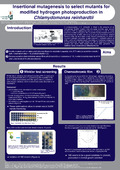
[en] The unicellular green alga Chlamydomonas reinhardtii has evolved the ability to redirect electrons from the photosynthetic chain to drive hydrogen production via chloroplast oxygen-sensitive hydrogenases. This process occurs under anaerobic conditions and provides a biological basis for solar-driven hydrogen production. Nevertheless, the yield is a major limitation for an economic viability and fundamental knowledge is still needed in order to have a better understanding of the process. In 2000, Melis and co-worker defined a protocol allowing a sustainable hydrogen production in sulfur deprivation condition. By adjustment of an existent protocol called the Winkler test, we are trying to isolate mutants with an attenuated photosynthesis to respiration capacity ratio (P/R ratio). This kind of mutants could be able to reach anoxia needed for hydrogenases activity without the stressful impact of sulfur deprivation. An insertional mutagenesis of Chlamydomonas has been carried out with an hygromycin resistance cassette and about 2500 transformants have generated and screened by the adapted Winkler test. We have isolated several oxygen-consuming mutants and the most promising one is subject to functional, molecular and genetic characterization. To discover new genes involved in hydrogenases activity, we are also planning to screen the same insertional library for mutants with attenuated levels of hydrogen photoproduction, using sensitive chemochromic sensor films which turn in blue in presence of hydrogen. We are currently making the chemochromic sensor WO3 films by dip-coating which is on the brink of being useable.
Emonds-Alt, Barbara ; Université de Liège - ULiège > 2e an. master bioch. & biol. moléc. & cell., fin. appr.
Cardol, Pierre ; Université de Liège - ULiège > Département des sciences de la vie > Génétique
Franck, Fabrice ; Université de Liège - ULiège > Labo de Bioénergétique
Remacle, Claire ; Université de Liège - ULiège > Département des sciences de la vie > Génétique
Other collaborator :
Vertruyen, Bénédicte ; Université de Liège - ULiège > Département de chimie (sciences) > Chimie inorganique structurale
Compère, Philippe ; Université de Liège - ULiège > Département des sciences et gestion de l'environnement > Département des sciences et gestion de l'environnement
Language :
English
Title :
Insertional mutagenesis to select mutants for modified hydrogen photoproduction in Chlamydomonas reinhardtii
Alternative titles :
[fr] Mutagenèse insertionelle afin d'isoler des mutants déficients pour la photoproduction d'hydrogène chez chlamydomonas reinhardtii
Publication date :
17 May 2011
Number of pages :
A0
Event name :
Colloque annuel de la Société Francaise de Potosynthèse
Event organizer :
Société Francaise de Potosynthèse
Event place :
Paris, France
Event date :
du 16 mais 2011 au 17 mai 2011
Audience :
International
Funders :
F.R.S.-FNRS - Fonds de la Recherche Scientifique [BE]