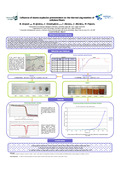
[en] The aim of the present work is to compare the effect of different steam explosion pretreatments on the thermal degradation of a bleached cellulose where components like hemicelluloses and lignin have already been removed by acid and alkaline treatments.
The results of this study show that thermal degradation of cellulose fibres, studied by TGA, is still limited for a temperature process below 240 °C. However, derivative TGA show that thermal stability of cellulose obtained by these conditions decreases with the increase of temperature.
For temperatures above 250°C, char level is higher at the end of the pyrolysis. According to the literature, the increase of the char level is correlated to an increase of the degradation product1. Determination of the degradation products in the liquor obtained after the pretreatment show an important increase of furfural and 5-hydroxymethylfurfural concentration with the temperature in agreement with the increase of the char level. These results confirm the important degradation of the cellulose fibres.
Disciplines :
Materials science & engineering
Author, co-author :
Jacquet, Nicolas ; Université de Liège - ULiège > Chimie et bio-industries > Chimie biologique industrielle
Quiévy, Nicolas
Vanderghem, Caroline ; Université de Liège - ULiège > Chimie et bio-industries > Chimie biologique industrielle
Devaux, Jacques
Blecker, Christophe ; Université de Liège - ULiège > Chimie et bio-industries > Technologie des industries agro-alimentaires
Paquot, Michel ; Université de Liège - ULiège > Chimie et bio-industries > Chimie biologique industrielle
Language :
English
Title :
Influence of steam explosion and thermal degradation of cellulose