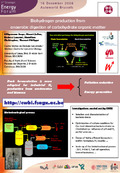
[en] Hydrogen has received wide attention in the last decade as a clean energy vector. The major advantage of energy from hydrogen is the zero carbon emissions, since the utilization of hydrogen, either via combustion or via fuel cells, results in pure water. At industrial scale, steam reformation of methane is currently the major hydrogen producing process. However recently, increasing interest has been paid on biological production of hydrogen gas. Indeed, biohydrogen generation from renewable biomass would reduce dependence on fossil fuel, decrease the carbon dioxide emissions and produce usable bioenergy. Biological production of hydrogen using anaerobic bacteria is an exciting and promising new area of technology development that offers the potential production of usable hydrogen from a variety of renewable resources such as carbohydrates from agriculture or agro-food industries. This biological system is called dark fermentation and the most interesting bacteria strains are Clostridium sp. The investigations carried out at CWBI involve selection and characterization of bacteria strains, optimization of the biotechnological process and design of highly efficient bioreactors.
Research center :
Centre Wallon de Biologie Industrielle
Disciplines :
Engineering, computing & technology: Multidisciplinary, general & others Microbiology Biotechnology
Author, co-author :
Hiligsmann, Serge ; Université de Liège - ULiège > Département des sciences de la vie > Biochimie et microbiologie industrielles
Masset, Julien ; Université de Liège - ULiège > Département des sciences de la vie > Biochimie et microbiologie industrielles
Beckers, Laurent ; Université de Liège - ULiège > Département des sciences de la vie > Biochimie et microbiologie industrielles
Hamilton, Christopher ; Université de Liège - ULiège > Centre Wallon de biologie industrielle
Thonart, Philippe ; Université de Liège - ULiège > Département des sciences de la vie > Biochimie et microbiologie industrielles
Language :
English
Title :
Biohydrogen production from anaerobic digestion of carbohydrate organic matter.
Publication date :
16 December 2008
Event name :
3rd Strategic Energy Forum
Event organizer :
FABI (Fédération Royale d'Associations Belges d'Ingénieurs Civils et d'Ingénieurs Agronomes et bioingénieurs - asbl)Koninklijke Vlaamse Ingenieursvereniging KVIV (Koninklijke Vlaamse Ingenieursvereniging) FEB/VOB (Federation of Enterprises in Belgium)
Etude de la production d'hydrogène par les bactéries anaérobies chimiotrophes (dark-fermentation)
Funders :
Région wallonne : Direction générale des Technologies, de la Recherche et de l'Energie - DGTRE ; Action de Recherches concertées ARC 07/12 04- ULg- Communauté française ; Fonds pour la formation à la Recherche dans l'Industrie et dans l'Agriculture (Communauté française de Belgique) - FRIA ; Fonds de la Recherche Scientifique (Communauté française de Belgique) - F.R.S.-FNRS