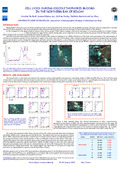
[en] Phytoplankton cell lysis occurs in natural populations and is often associated with viral activity and zooplankton grazing. Cell lysis rates are expected to increase towards the decaying phase of the bloom and may be associated with enhanced microbial activity and export of particulate matter to the seafloor. Their estimation was based on the measurement of esterase (a cytoplasmic enzyme) activity expected to appear in the water only after cell breakage. Field investigations, supported by remote sensing data, were conducted in recent years during late spring in the Northern Bay of Biscay, where frequent and recurrent coccolithophorid blooms are observed. Results on cell lysis rates determined in surface waters will be presented with relevant biogeochemical parameters (temperature, particulate organic and inorganic carbon, transparent exopolymer particles, nutrients, chlorophyll a) in order to investigate phytoplankton dynamics in relation to coccolithophorid development. The use of this parameter to characterize bloom termination, especially during coccolithophorid blooms will be discussed.
De Bodt, Caroline; Laboratoire d’Océanographie Chimique et Géochimie des Eaux, Faculté des Sciences, Université Libre de Bruxelles, B-1050 Brussels, Belgium
Harlay, Jérôme ; Université de Liège - ULiège > Département d'astrophys., géophysique et océanographie (AGO) > Océanographie chimique
Roevros, Nathalie; Laboratoire d’Océanographie Chimique et Géochimie des Eaux, Faculté des Sciences, Université Libre de Bruxelles, B-1050 Brussels, Belgium
Chou, Lei; Laboratoire d’Océanographie Chimique et Géochimie des Eaux, Faculté des Sciences, Université Libre de Bruxelles, B-1050 Brussels, Belgium
Language :
English
Title :
Cell lysis during coccolithophorid blooms in the Northern Bay of Biscay