[en] • OBJECTIVE: Escherichia coli is a microorganism widely used in the industry for the
production of recombinant proteins. The performances obtained at the laboratory level
are not reproducible at a large scale. Actually, the mixing operation is not efficient
enough: gradients of glucose and oxygen appear when operating in fed-batch mode
(addition of glucose during the culture). These gradients cause adverse impacts on the
production of biomass and recombinant protein. The aim of this work is to use the
microbial population as biocaptor of the encoutered stress inside heterogeneous
industrial bioreactors to better scale-up and regulate these reactors.
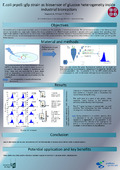
• MATERIALS AND METHODS: A plasmid carrying a stress promoter followed by
the coding sequence of the Green Fluorescent Protein (GFP) is introduced in the
bacterial host (in our case, the strain E. coli K12 will be considered as a model
organism). When the cell is submitted to given stress condition, GFP synthesis is
induced and accumulated into the cytoplasm, leading to the increase of the cell's
fluorescence. Flow cytometry detection is used in order to quantify the fluorescence at
the single cell level. Obtained results are frequency histograms of fluorescenceintensity
in the microbial population
• RESULTS: The rpoS gene is a gene of the general stress response, mainly induced at
the entrance to stationary phase (during a lack of glucose). The tracking of the GFP
fluorescence linked to the activation / repression of the rpoS promoter gives good
results. Indeed, there is appearance of a segregation at the level of the GFP content
among the microbial population. The intensity of the segregation, as well as its time of
appearance during the culture can be related to the bioreactor mixing efficiency.
• CONCLUSION: prpoS::gfp strains can be used as biosensors of the heterogeneity of
glucose encountered inside industrial reactors.
• POTENTIAL APPLICATIONS & KEY BENEFITS: These strains could be used to
validate a fed-batch regulation (addition of glucose) at the industrial level.
Research center :
Unité de bio-industries / Gembloux Agro Bio-Tech / Université de Liège