| Reference : Can we really get rid of Japanese knotweed clones? Two years of management tests in Belg... |
| Scientific congresses and symposiums : Poster | |||
| Life sciences : Environmental sciences & ecology Life sciences : Phytobiology (plant sciences, forestry, mycology...) | |||
| http://hdl.handle.net/2268/77952 | |||
| Can we really get rid of Japanese knotweed clones? Two years of management tests in Belgium | |
| English | |
Monty, Arnaud [Université de Liège - ULg > Forêts, Nature et Paysage > Biodiversité et Paysage >] | |
Delbart, Emmanuel [Université de Liège - ULg > Forêts, Nature et Paysage > Biodiversité et Paysage >] | |
Mahy, Grégory [Université de Liège - ULg > Forêts, Nature et Paysage > Biodiversité et Paysage >] | |
Vanderhoeven, Sonia [Université de Liège - ULg > Forêts, Nature et Paysage > Biodiversité et Paysage >] | |
| Sep-2010 | |
| A0 | |
| No | |
| International | |
| Neobiota - Biological Invasions in a Changing World - from Science to Management | |
| Copenhagen | |
| Denmark | |
| [en] Fallopia japonica ; Management ; Stem-injection | |
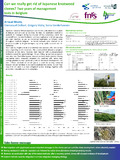
| [en] Japanese knotweed Fallopia japonica is an extremely abundant invasive plant in Belgium and surrounding countries. To date, no eradication method is available for managers facing the invasion of this rhizomatous plant. We tested different chemical herbicides and two application methods (spraying and stem injection), as well as mechanical treatments, on Fallopia clones throughout southern Belgium. The tested methods were selected to be potentially usable by Belgian managers, e.g. using legally accepted rates for herbicides.
Stem volume, height and density reduction was assessed after one or two years depending on the treatment. No tested method allowed a complete eradication of the clone. However, stem injection with glyphosate-based herbicide caused the highest damage. The year following injection, no sprouts were observed. Two following year, however, stunted shoots sprouted. Among mechanical control measures, repeated cuts combined with native trees cuttings plantations most appreciably reduced knotweed development. The most efficient methods we tested appear as tools for curbing knotweed invasion but are not likely to be used to eradicate the species. As such they should be included in a more integrated control strategy, together with prevention and public awareness campaigns. | |
| Région wallonne : Direction générale des Ressources naturelles et de l'Environnement - DGRNE | |
| Researchers ; Professionals ; Students ; General public | |
| http://hdl.handle.net/2268/77952 |
| File(s) associated to this reference | ||||||||||||||
|
Fulltext file(s):
| ||||||||||||||
All documents in ORBi are protected by a user license.