| Reference : Which evolutionary mechanisms allow Senecio inaequidens DC. to face a changing climate? ... |
| Scientific congresses and symposiums : Poster | |||
| Life sciences : Phytobiology (plant sciences, forestry, mycology...) Life sciences : Environmental sciences & ecology | |||
| http://hdl.handle.net/2268/74615 | |||
| Which evolutionary mechanisms allow Senecio inaequidens DC. to face a changing climate? A synthesis | |
| English | |
Monty, Arnaud [Université de Liège - ULg > Forêts, Nature et Paysage > Biodiversité et Paysage >] | |
Mahy, Grégory [Université de Liège - ULg > Forêts, Nature et Paysage > Biodiversité et Paysage >] | |
| Sep-2010 | |
| No | |
| Neobiota - Biological Invasions in a Changing World - from Science to Management | |
| Copenhagen | |
| Denmark | |
| [en] Ragwort ; Genetic drift ; Adaptation ; Maternal effects ; Seed mass ; Dispersal | |
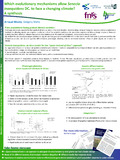
| [en] Plant populations are expected to face gradual climatic variation in the next decades. Understanding and quantifying evolutionary and non-evolutionary mechanisms allowing populations response to climate is therefore crucial to anticipate the actual consequences of climate change on plants. However, studying the direct effects of climate change in wild populations is of little anticipating interest… there invasive plants can help!
We studied the sources of phenotypic variation in populations that gradually invaded different climatic zones over the last century, and assessed the role of local adaptation, non-adaptive genetic differentiation, phenotypic plasticity and environmental maternal effects in plant population response to climate. | |
| Fonds de la Recherche Scientifique (Communauté française de Belgique) - F.R.S.-FNRS ; Fonds de la Recherche Fondamentale Collective d'Initiative des Chercheurs - FRFC | |
| http://hdl.handle.net/2268/74615 |
| File(s) associated to this reference | ||||||||||||||
|
Fulltext file(s):
| ||||||||||||||
All documents in ORBi are protected by a user license.