[en] Introduction:
Cardiac troponin I and T are specific markers of myocardial injury that are widely used for
the diagnosis of acute coronary syndrome (ACS). In acute chest pain without ST-segment
elevation, they are used to differentiate unstable angina from non ST-segment elevation
myocardial infarction (NSTEMI). Recently, troponin assays with higher analytical
sensitivities became available to enable the detection of minor myocardial damage and
identify individuals at higher risk for ACS. As a result of its high tissue-specificity, cardiac
troponin T and I are cardio-specific, highly sensitive markers for myocardial damage. The aim
of this study was to evaluate the new higher sensitive troponin (T and I) in patients with stable
angina and acute chest pain without ST-segment elevation.
Methods: Sixty subjects (mean age : 65.5± 11 years), were included: 20 healthy controls, 20
patients with stable angina, 9 with unstable angina (troponin-) and 18 patients with NSTEMI
myocardial infarction (troponin+). The protocol was approved by the ethic committee of the
University of Liège (Belgium). High sensitive troponin T (hsTnT) determination was realized
on heparin plasma by electrochemiluminescence immunoassay on Modular E (Roche
Diagnostic). Troponin I II (TnI II) is a chemiluminescent microparticle immunoassay for the
quantitative determination of cardiac troponin-I in heparine plasma on the ARCHITECT i
System (Abbott Diagnostic). The lower detection limit of these assays was 0.005μg/L for
hsTnT and 0.01μg/L for TnI II.
Stastistical analysis was performed using t test. P value <0.05 was considered significant.
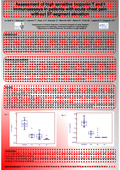
Results: HsTNT levels were 0.003(0.003, 0.004) [median baseline (1st, 3rd quartile)]ng/ml in
controls, 0.0075 (0.00475, 0.014) ng/ml in stable angina, 0.011(0.006, 0.012) ng/ml in
unstable angina and 0.3715 (0.1795, 1.00725) ng/ml in NSTEMI ACS. TnI II levels were 0
(0, 0.001) ng/ml in controls and in patients with stable angina, 0.07 (0.005, 0.014) ng/ml in
unstable angina and 1.4475 (0.0407, 2.656) ng/ml in NSTEMI.
HsTNT and TnI II levels were significantly increased in NSTEMI as compared to control
subjects, patients with stable and unstable angina. TnI II levels were also increased in unstable
angina as compared to controls.
Conclusion: In our population, TnI II was more sensitive than hsTNT to detect minor
myocardial damage in patients with unstable angina as compared to controls. Therefore,
future studies will have to determine whether TnI II might contribute to better risk
stratification and treatment strategy in this group of patients.
Disciplines :
Laboratory medicine & medical technology Cardiovascular & respiratory systems
Garweg, Christophe ; Université de Liège - ULiège > Département des sciences cliniques > Département des sciences cliniques
Laurent, Terry
Kaux, Jean-François ; Université de Liège - ULiège > Département des sciences cliniques > Département des sciences cliniques
Deroyer, Céline ; Université de Liège - ULiège > Département de pharmacie > GIGA-R : Chimie médicale
Merville, Marie-Paule ; Université de Liège - ULiège > Département de pharmacie > Chimie médicale
Melon, Pierre ; Université de Liège - ULiège > Cardiologie
Fillet, Marianne ; Université de Liège - ULiège > Département de pharmacie > Analyse des médicaments
Legrand, Victor ; Université de Liège - ULiège > Département des sciences cliniques > Cardiologie
Chapelle, Jean-Paul ; Université de Liège - ULiège > Département de pharmacie > Chimie médicale
Language :
English
Title :
Assessment of high sensitive troponin T and I immunoassays in patients with acute chest
Publication date :
July 2010
Event name :
2010 AACC’s Annual Meeting
Event organizer :
American Association for Clinical Chemistry
Event place :
Anaheim, United States
Event date :
July 25-29, 2010
Audience :
International
Journal title :
Clinical Chemistry
ISSN :
0009-9147
eISSN :
1530-8561
Publisher :
American Association for Clinical Chemistry, Washington, United States - District of Columbia
Special issue title :
Abstracts of the Scientific Posters, 2010 AACC Annual Meeting
Volume :
56
Issue :
S6
Pages :
A127
Peer reviewed :
Peer Reviewed verified by ORBi
Commentary :
Abstract being selected to be presented at the Genzyme Student Poster Contest at the 2010 AACC Annual Meeting in Anaheim, California.
I do not have any objections to you using this presentation, but please remember that the material is copyrighted by my medical school, and that the intellectual property is recognised as being mine. Therefore, each and every single slide will have to be acknowledged in writing on the slide itself as being mine, and the medical school logo should be displayed (you can copy and paste it from the first slide).