Soil heterotrophic respiration; Temperature sensitivity; Short-term; Crop soil; Laboratory incubation; Respiration hétérotrophe du sol; Sensibilité à la température; Court terme; Sol agricole; Incubation en laboratoire
Abstract :
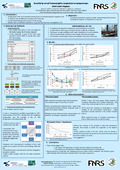
[en] Soil respiration is mostly affected by temperature variations but there is still much debate regarding its temperature sensitivity. Especially the difference between short- and long-term responses driven by changes in microbial activity and population respectively is addressed here. To this end, an incubation experiment is set up with soil samples taken from the surface layer (0-25cm) of a bare area at the Carboeurope agricultural site of Lonzée in Belgium. After homogenization, they are placed into incubators at three different temperatures, namely 5, 15 and 25°C for 2 weeks. Temperature is regulated by Peltier systems that warm up or cool down a bath containing jars with soil samples. All jars are continuously aerated to prevent CO2 from accumulating inside. Moisture levels in the jars are regularly checked and adjusted to ensure that the soil moisture is optimal for soil respiration. Twice a week, short term temperature response is tested by changing incubation temperatures in the range 5 - 35°C. During these cycles, CO2 fluxes are measured at each temperature step with a closed dynamic chamber system. Microbial biomass and hot water-extractable carbon are determined two times during a temperature cycle, allowing a follow up of the evolution of these two variables through a cycle.
A comparison between the respiration rates, microbial biomasses and extractable carbon will be presented and would allow a better understanding of the dynamics of the heterotrophic respiration response to temperature in agricultural soils. In the future, other experiments could be derived from this one to focus on substrate availability or soil moisture impacts on soil respiration.
Research center :
Université de Liège - Gembloux Agro-Bio Tech
Disciplines :
Environmental sciences & ecology
Author, co-author :
Buysse, Pauline ; Université de Liège - ULiège > Sciences et technologie de l'environnement > Physique des bio-systèmes
Goffin, Stéphanie ; Université de Liège - ULiège > Sciences et technologie de l'environnement > Physique des bio-systèmes
Carnol, Monique ; Université de Liège - ULiège > Département des sciences et gestion de l'environnement > Ecologie végétale et microbienne
Malchair, Sandrine ; Université de Liège - ULiège > Département des sciences et gestion de l'environnement > Ecologie végétale et microbienne
Debacq, Alain ; Université de Liège - ULiège > Sciences et technologie de l'environnement > Physique des bio-systèmes
Aubinet, Marc ; Université de Liège - ULiège > Sciences et technologie de l'environnement > Physique des bio-systèmes
Language :
English
Title :
Sensitivity of soil heterotrophic respiration to temperature: short-term impacts.
Alternative titles :
[fr] Sensibilité de la respiration hétérotrophe du sol à la température: impacts à court terme.
Publication date :
September 2009
Event name :
International Carbon Dioxide Conference (ICDC)
Event place :
Jena, Germany
Event date :
du 13 au 19 septembre 2009
Audience :
International
Name of the research project :
Modélisation de la respiration de sols agricoles.
Funders :
F.R.S.-FNRS - Fonds de la Recherche Scientifique [BE]