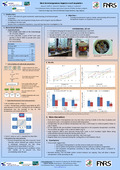
[en] Despite considerable recent work on soil heterotrophic respiration, a mechanistic understanding of this process is still missing. Temperature is one of the most important driving factors. It can influence the mechanism through multiple ways, whose importance may vary with time. An incubation experiment is set up to study short-term temperature influences on soil microbial respiration and its evolution through time. Soil samples are taken in spring from the surface layer (0-25cm) of a bare agricultural loamy soil situated in Lonzée in Belgium (Hesbaye region) and are homogenized before being placed into incubators at three different temperatures, namely 5, 15 and 25°C. Temperature is regulated by Peltier systems that warm up or cool down a sand bath containing jars with soil samples.
Once a week, incubation temperatures are increased and decreased by 5°C-steps, starting from each incubator temperature, to achieve a one-day temperature cycle between 5 and 35°C. CO2 flux measurements are performed at each temperature step by a closed dynamic chamber system, after the temperature has stabilized in the samples. Microbial biomass (C and N) is determined four times during the temperature cycle by the fumigation-extraction technique and soil labile carbon is measured at the beginning of each cycle by the hot-water extraction method. Moisture levels in soil samples are regularly checked and adjusted to keep optimal soil moisture content. Between CO2 flux measurements, jars are left open to ensure that anaerobic conditions do not occur.
Further investigations could include an assessment of the importance of substrate availability and depletion on microbial activity, and a model development related to the results provided by this experiment.
Research center :
Université de Liège - Gembloux Agro-Bio Tech
Disciplines :
Environmental sciences & ecology
Author, co-author :
Buysse, Pauline ; Université de Liège - ULiège > Sciences et technologie de l'environnement > Physique des bio-systèmes
Goffin, Stéphanie ; Université de Liège - ULiège > Sciences et technologie de l'environnement > Physique des bio-systèmes
Carnol, Monique ; Université de Liège - ULiège > Département des sciences et gestion de l'environnement > Ecologie végétale et microbienne
Malchair, Sandrine ; Université de Liège - ULiège > Département des sciences et gestion de l'environnement > Ecologie végétale et microbienne
Debacq, Alain ; Université de Liège - ULiège > Sciences et technologie de l'environnement > Physique des bio-systèmes
Aubinet, Marc ; Université de Liège - ULiège > Sciences et technologie de l'environnement > Physique des bio-systèmes
Language :
English
Title :
Short-term temperature impacts on soil respiration.
Alternative titles :
[fr] Impacts de la température à court terme sur la respiration du sol.
Publication date :
June 2009
Event name :
Soil Organic Matters
Event organizer :
Rothamsted Research Centre
Event place :
Harpenden, United Kingdom
Event date :
du 23 au 25 juin 2009
Audience :
International
Name of the research project :
Modélisation de la respiration de sols agricoles.
Funders :
F.R.S.-FNRS - Fonds de la Recherche Scientifique [BE]