| Reference : Influence of geometry in the case of relative positioning with GNSS |
| Scientific congresses and symposiums : Poster | |||
| Physical, chemical, mathematical & earth Sciences : Space science, astronomy & astrophysics | |||
| http://hdl.handle.net/2268/33587 | |||
| Influence of geometry in the case of relative positioning with GNSS | |
| English | |
| [fr] Influence de la géométrie de la constellation dans le cas du positionnement relatif par GNSS | |
Wautelet, Gilles [Université de Liège - ULg > > > Doct. sc. (géographie - Bologne)] | |
| Lejeune, Sandrine [> >] | |
Lonchay, Matthieu [Université de Liège - ULg > Département de géographie > Géodésie et positionnement par satellite >] | |
Warnant, René [Université de Liège - ULg > Département de géographie > Géodésie et positionnement par satellite >] | |
| 18-Nov-2009 | |
| No | |
| International | |
| Sixth European Space Weather Week | |
| du 16 novembre 2009 au 20 novembre 2009 | |
| European Spatial Agency (ESA) | |
| Bruges | |
| Belgium | |
| [en] GNSS ; Ionosphere ; Positioning ; Satellite geometry | |
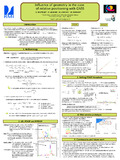
| [en] Relative positioning with GNSS is generally used to achieve precise positions in the frame of critical applications (surveying, photo-control...). On this basis, we have developed a software which allows to compute a positioning error due to the ionosphere only using reference stations belonging to the Belgian Dense Network (BDN). This network consists in 66 GPS (dual-frequency) receivers over the whole Belgium. The drawback of this method is that this computation needs the design matrix which contains coefficients depending on satellite constellation geometry. Therefore, like for absolute positioning, a poor geometry (evaluated by the Dilution of Precision, or DOP) can also lead to large positioning error that cannot be separated from the one due to ionospheric effects, and in particular the small-scale structures.
The main goal of this paper is to build a similar index to DOP for relative positioning in our software to be able to separate the ionospheric effects from the geometric ones. The final step is to study the feasability of a service for users of relative positioning using the BDN. The objective is to give in post-processing the positioning accuracy degradation for all BDN baselines and to associate a colour scheme to the different degradation classes created. | |
| European Spatial Agency (ESA) | |
| Researchers ; Professionals | |
| http://hdl.handle.net/2268/33587 |
| File(s) associated to this reference | ||||||||||||||||||||||||||
|
Fulltext file(s):
Additional material(s):
| ||||||||||||||||||||||||||
All documents in ORBi are protected by a user license.