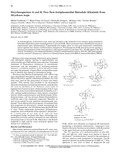
[en] A reinvestigation of Strychnos icaja roots has resulted in the isolation of two tertiary quasi-symmetric bisindole alkaloids named strychnogucines A (1) and B (2). Their structures were identified by means of spectroscopic data interpretation. Compound 2 was highly active in vitro and compound 1 moderately active against four strains of Plasmodium falciparum. Strychnogucine B (2) was more active against a chloroquine-resistant strain than against a chloroquine-sensitive one (best CI(50), 80 nM against the W2 strain). In addition, this compound showed a selective antiplasmodial activity with 25-180 times greater toxicity toward P. falciparum, relative to cultured human cancer cells (KB) or human fibroblasts (WI38).
Frederich, Michel ; Université de Liège - ULiège > Département de pharmacie > Pharmacognosie
De Pauw-Gillet, Marie-Claire ; Université de Liège - ULiège > Département des sciences biomédicales et précliniques > Histologie - Cytologie - Département des sciences biomédicales et précliniques
Prosperi, Christelle ; Université de Liège - ULiège > Département de physique > Département de physique
Tits, Monique ; Université de Liège - ULiège > Département de pharmacie > Phytochimie et phytothérapie
Brandt, V.
Penelle, J.
Hayette, Marie-Pierre ; Centre Hospitalier Universitaire de Liège - CHU > Microbiologie médicale
De Mol, Patrick ; Université de Liège - ULiège > Département des sciences biomédicales et précliniques > Microbiologie médicale et virologie médicale
Angenot, Luc ; Université de Liège - ULiège > Département de pharmacie > Pharmacognosie
Language :
English
Title :
Strychnogucines a and B, Two New Antiplasmodial Bisindole Alkaloids from Strychnos Icaja
Publication date :
January 2001
Journal title :
Journal of Natural Products
ISSN :
0163-3864
eISSN :
1520-6025
Publisher :
American Chemical Society, Washington, United States - District of Columbia
Frederich, M.; Hayette, M. P.; Tits, M.; De Mol, P.; Angenot, L. Antimicrob. Agents Chemother, 1999, 43, 2328-2331.
Frederich, M.; Tits, M.; Hayette, M. P.; Brandt, V.; Penelle, J.; DeMol, P.; Llabres, G.; Angenot, L. J. Nat. Prod. 1999, 62, 619-621.
Frederich, M.; De Pauw-Gillet, M. C.; Llabres, G.; Tits, M.; Hayette, M. P.; Brandt, V.; Penelle, J.; De Mol, P.; Angenot, L. Planta Med. 2000, 66, 262-269.