stable isotope; seagrass; Posidonia oceanica; macro-fauna; mixing model
Abstract :
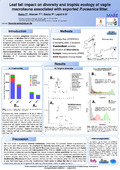
[en] In the Mediterranean Sea, Posidonia oceanica meadows produce a huge amount of detritus, evaluated up to 300 to 2000 g dry wt m-2 yr-1. This litter is mainly composed of dead leaves but also of uprooted P.oceanica shoots and drift macro-algae from adjacent rocky bottoms. Although rich in refractory materials (lignin) and poor in P and N, these underwater accumulations of leaves are colonised by fungi, micro-algae (like diatoms), bacteria, but also by micro and macrofauna assemblages. These organisms could play an important role in leaf litter degradation and enrichment, but also in energy and carbon transfer from P.oceanica to higher trophic levels in adjacent coastal ecosystems.
In this study we focus on the vagile macro-fauna (invertebrates with a size > 500µm) inhabiting the exported litter accumulations of the Calvi Bay (France). We took standardised samples at two different sites (a sheltered one and an exposed one) before and after leaf fall. We emphasised that crustaceans represent 65 – 85% of the biodiversity, followed by annelids and molluscs, representing respectively 10-20% and 10-15% of the diversity. That general pattern differs between sampling sites and we highlighted changes after leaf fall at both sites. In order to assess the impact of the autumn period litter input on the trophic structure of these invertebrates, we conducted gut contents observations and “bulk” stable isotope analysis. The isotopic compositions of C and N stable isotopes of the potential detritic food sources and of the most abundant invertebrate’s species were measured using EA-IRMS. We finally focused on the two most abundant Gammaridean Amphipoda species representing up to about 60% of the vagile macrofauna found in litter accumulations: Gammarella fucicola and Gammarus aequicauda. The results of their isotopic measurements were used in the “SIAR” Bayesian mixing model to calculate the potential contribution of their potential food sources.
Research center :
MARE - Centre Interfacultaire de Recherches en Océanologie - ULiège
Remy, François ; Université de Liège - ULiège > Département de Biologie, Ecologie et Evolution > Océanologie
Mascart, Thibaud ; Université de Liège - ULiège > Département de Biologie, Ecologie et Evolution > Océanologie
Dauby, Patrick ; Université de Liège - ULiège > Département de Biologie, Ecologie et Evolution > Systématique et diversité animale
Lepoint, Gilles ; Université de Liège - ULiège > Département de Biologie, Ecologie et Evolution > Océanologie
Language :
English
Title :
Leaf fall impact on diversity and trophic ecology of vagile macrofauna associated with exported P.oceanica litter
Alternative titles :
[fr] Impact de la chute des feuilles sur la biodiversité et la diversité trophique de la macro-faune vagile associée aux accumulations exportées de litière de P. oceanica
Publication date :
20 August 2012
Number of pages :
A0
Event name :
8th ISOECOL International Conference on Applications of Stable Isotope Techniques to Ecological Studies
Event organizer :
IFREMER
Event place :
Brest, France
Event date :
du 20 août 2012 au 24 août 2012
Audience :
International
Funders :
FRIA - Fonds pour la Formation à la Recherche dans l'Industrie et dans l'Agriculture [BE]