Poly (2-dimethylamino-ethylmethacrylate); red blood cells; polycation; stealth red blood cells; immunocamouflage; cell surface engineering; universal red blood cells
Abstract :
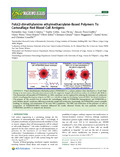
[en] Poly(2-dimethylamino-ethylmethacrylate) (PDMAEMA) is a cationic polymer when dissolved in a 7.4 pH fluid. Owing to its ionic nature, this polycation interacts with the negatively charged cell membrane surface of red blood cells (RBCs). The electrostatic self-assembly of PDMAEMA on RBCs membrane can be employed for inducing the formation of a polymeric shield camouflaging blood group antigens on RBCs as a valuable strategy for developing “universal RBCs” for blood transfusion. The purpose of this research was to evaluate the camouflaging ability of PDMAEMA homopolymers and PDMAEMA-copoly(nethylene glycol) copolymers differing in molecular weight and architecture. Surprisingly, the PDMAEMAs caused a partially masking, no masking, and sensitization of the same RBCs population. The MW and architecture of the polymers as well as temperature of PDMAEMA-RBCs treatment influenced the results observed. Herein, the very particular reactivity of PDMAEMAs and RBCs is analyzed and discussed.
Research center :
CEIB - Centre Interfacultaire des Biomatériaux - ULiège
COTTIN, Sophie ; Centre Hospitalier Universitaire de Liège - CHU > Hématologie biologique et immuno hématologie
Flebus, Luca ; Université de Liège - ULiège > Centre interfacultaire des biomatériaux (CEIB)
Pozos-Guillén, Amaury
Flores, Héctor
Heinen, Ernst ; Université de Liège - ULiège > Département des sciences biomédicales et précliniques > Histologie humaine
Jolois, Olivier ; Université de Liège - ULiège > Département des sciences biomédicales et précliniques > Histologie humaine
GERARD, Christiane ; Centre Hospitalier Universitaire de Liège - CHU > Hématologie biologique et immuno hématologie
MAGGIPINTO, Gianni ; Centre Hospitalier Universitaire de Liège - CHU > Hématologie biologique et immuno hématologie
Sevrin, Chantal ; Université de Liège - ULiège > Centre interfacultaire des biomatériaux (CEIB)
Grandfils, Christian ; Université de Liège - ULiège > Département des sciences biomédicales et précliniques > Biochimie et physiologie générales, et biochimie humaine
Language :
English
Title :
Poly(2-dimethylamino ethylmethacrylate)-Based Polymers To Camouflage Red Blood Cell Antigens
Publication date :
2012
Journal title :
Biomacromolecules
ISSN :
1525-7797
eISSN :
1526-4602
Publisher :
American Chemical Society, Washington, United States - District of Columbia
Olsson, M.L., Clausen H., Br., (2008) J. Hamaetol., 140, pp. 3-12
Olsson, M.L., Hill, C.A., De La Vega, H., Liu, Q.P., Stroud, M.R., Valdinocci, J., Moon, S., Kruskall, M.S., (2004) Transfus. Clin. Biol., 11, pp. 33-39
Le, Y., Scott, M.D., (2010) Acta Biomater., 6, pp. 2631-2641
Mansouri, S., Fatisson, J., Miao, Z., Merhi, Y., Winnik, F.M., Tabrizian, M., (2009) Langmuir, 25, pp. 14071-14078
Mansouri, S., Merhi, Y., Winnik, F.M., Tabrizian, M., (2011) Biomacromolecules, 12, pp. 585-592
Elbert, D.L., Hubbell, J.A., (1998) Chem. Biol., 5, pp. 177-183
Riquelme, B.D., Dumas, D., Fontana, A., Delannoy, M., Valverde, J.R., Sondag, D., Grandfils, C., (2011) J. Biomed. Mater. Res., Part A, 99 A, pp. 445-454
Cerda-Cristerna, B.I., Flores, H., Pozos-Guillen, A., Perez, E., Sevrin, C., Grandfils, C.J., (2011) Controlled Release, 153, pp. 269-277
McCarthy, D.A., (2007) Flow Cytometry, pp. 59-112. , Macey, M. G., Ed.
Humana Press: Totowa, NJ
Reid, M.E., Yahalom, V., (2000) Bailliere's Best Pract. Res., Clin. Haematol., 13, pp. 485-509
Su, Y.L., Li, C., (2007) J. Colloid Interface Sci., 316, pp. 344-349
Grandfils, C., Foresto, P., Riquelme, B., Valverde, J., Sondag-Thull, D., (2008) J. Biomed. Mater. Res., Part A, 84, pp. 535-544
Mayhew, E., Harlos, J.P., Juliano, R.L., (1973) J. Membr. Biol., 14, pp. 213-228
Moreau, E., Domurado, M., Chapon, P., Vert, M., Domurad, D., (2002) J. Drug Targeting, 10, pp. 161-173
Moreau, E., Ferrari, I., Drochon, A., Chapon, P., Vert, M., Domurado, D., (2000) J. Controlled Release, 64, pp. 115-128
Chasis, J.A., Mohandas, N., (1992) Blood, 80, pp. 1869-1879
Li, G., Stewart, R., Conlan, B., Gilbert, A., Roeth, P., Nair, H., (2002) Vox Sang., 83, pp. 332-338
Reverberi, R., Reverberi, L., (2007) Blood Transfus., 5, pp. 227-240
Lalezari, P., Jiang, A.F., (1980) Transfusion, 20, pp. 206-211
Fung, Y., Mechanical properties of living tissues (1993) Biomechanics, pp. 113-114. , 2nd ed. Springer: New York
Kovačević, D., Glavanović, S., Peran, N., (2006) Colloids Surf., A, 277, pp. 177-182
Coller, B., (1980) Blood, 55, pp. 276-281
Van De Wetering, P., Zuidam, N.J., Van Steenbergen, M.J., Van Der Houwen, O.A.G.J., Underberg, W.J.M., Hennink, W.E., (1998) Macromolecules, 31, pp. 8063-8068
Ward, M.A., Georgiou, T.K., (2010) J. Polym. Sci., Part A: Polym. Chem., 48, pp. 775-783