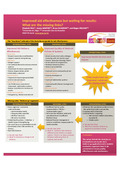
[en] Objectives: The objective is to analyze the content of the Paris Declaration (PD) on aid effectiveness and Accra Agenda for Action (AAA), and their practical implications for the health sector in aid-recipient countries.
Design/methods: The study draws on (i) a critical analysis of the two declarations, (ii) a review of the literature on their implementation and (iii) interviews of people in charge of implementing them – both donors and government representatives.
Results: The PD and AAA both have a "missing link" between, on the one hand, international cooperation policies (five pillars of the PD) and national development (health) plans; and, on the other hand, the operational level that is supposed to deliver results. They presume that by changing aid management and respecting a few principles, development results will automatically improve as through a "black box". The influence of international and national policies over health systems, service providers’ behaviour and health impacts is not treated at all by the agenda for aid effectiveness, while it is crucial for its success. Moreover, that agenda is mostly dealt with at a too high level (international forums or at best national sector level), thus deepening the disconnexion from field realities.
Conclusions/policy implications: This "missing link" entails the risk that, if the "black box" does not perform as expected – that is, if health systems and health service providers’ behaviour do not evolve in a positive way – and health impacts do not improve, the aid effectiveness agenda may be rejected at all, notwithstanding its (incomplete) added value. Hence the need to closely monitor the processes of national health plans implementation, so in order to better understand how these processes are translated on the field and what could be done to ensure that health service delivery and health results ultimately improve.
Disciplines :
Public health, health care sciences & services International economics
Author, co-author :
Paul, Elisabeth ; Université de Liège - ULiège > Institut des sciences humaines et sociales > Sociologie du développement
Dujardin, Bruno; Université Libre de Bruxelles - ULB > Ecole de Santé publique
Ireland, Megan; Université Libre de Bruxelles - ULB > Ecole de Santé publique
Martini, Jessica; Université Libre de Bruxelles - ULB > Ecole de Santé publique
Language :
English
Title :
Improved Aid Effectiveness but Waiting for Results: What are the Missing Links?
Publication date :
2010
Event name :
First Global Symposium on Health Systems Research
Event place :
Montreux, Switzerland
Event date :
16-19 November 2010
Audience :
International
Name of the research project :
GRAP-PA Santé
Funders :
CUD - Commission Universitaire pour le Développement [BE]