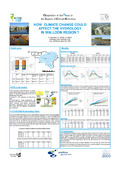
[en] Research on climate change and its impacts on hydrology are increasingly important nowadays. AMICE project focuses on the adaptation of the Meuse to the impacts of climate change. On this study, we focus on the Walloon tributaries of the Meuse river, and more specifically on the Vesdre and the Lesse sub-catchments.
Climate change scenarios are outputs of the CCI-HYDR Perturbation Tool for time slice 2020-2050 and 2070-2100. This tool allows us to build climate change time series and to use it as input of our hydrological models. The most pessimistic and the most optimistic scenarios are selected.
The hydrological model used is called EPICGrid and it is a physically based distributed model at catchment scale. EPICGrid used the perturbed meteorological data to provide hydrograms for the different scenarios and time slice for the Vesdre and the Lesse sub-catchments.
It appears that for the Vesdre daily discharge with a return period of 100 years (Qd100) could varies between -3% and +27% when the mean annual 7-day Minimum flow with a return period of 50 years (MAM750) varies between -37% and +16% for 2070-2100. For the Lesse, Qd100 varies between -30% and +50% when MAM750 varies between -21% and +28% for 2070-2100.
The broad range of discharge variations reflects the broad range of meteorological variation. These results will be used further in the AMICE project to build an adaptation strategy.
Disciplines :
Environmental sciences & ecology
Author, co-author :
Bauwens, Alexandra ; Université de Liège - ULiège > Gembloux Agro-Bio Tech > Hydrologie et Hydraulique Agricole
Sohier, Catherine ; Université de Liège - ULiège > Gembloux Agro-Bio Tech > Hydrologie et Hydraulique Agricole
Degre, Aurore ; Université de Liège - ULiège > Gembloux Agro-Bio Tech > Hydrologie et Hydraulique Agricole
Language :
English
Title :
How Climate Change Could Affect The Hydrology In Walloon Region ?
Publication date :
22 April 2010
Number of pages :
A0
Event name :
3ème Symposium International de la Meuse
Event organizer :
Région Wallonne (Direction Générale Agriculture, Ressources Naturelles et Environnement) Université de Liège (Aquapôle) Facultés Universitaires de Namur Commision Internationale de la Meuse