| Reference : Using fatty acid contents in milk to improve fertility of dairy cows? |
| Scientific congresses and symposiums : Poster | |||
| Life sciences : Animal production & animal husbandry Life sciences : Genetics & genetic processes | |||
| http://hdl.handle.net/2268/119412 | |||
| Using fatty acid contents in milk to improve fertility of dairy cows? | |
| English | |
Bastin, Catherine [Université de Liège - ULg > Sciences agronomiques > Zootechnie >] | |
| Berry, D.P. [ > > ] | |
Soyeurt, Hélène [Université de Liège - ULg > Sciences agronomiques > Zootechnie >] | |
Gengler, Nicolas [Université de Liège - ULg > Sciences agronomiques > Zootechnie >] | |
| 10-Feb-2012 | |
| No | |
| No | |
| National | |
| 17th Symposium on Applied Biological Sciences | |
| February 10, 2012 | |
| Leuven | |
| Belgium | |
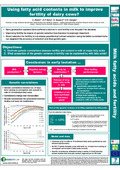
| [en] Improving dairy cow fertility by means of genetic selection has become increasingly important over
the last years in order to overcome the declining cow fertility. This study investigated whether the fatty acids profile in milk could be used as an early predictor of genetic merit for fertility. Genetic covariances among 17 fatty acid contents in milk and the number of days from calving to conception were estimated from 29,792 first-parity Holstein cows. Results substantiated the unfavorable relationship among fertility and body fat mobilization in early lactation. Also, about 75% of the genetic variability of fertility was explained by the variability in milk fatty acids profile over the lactation indicating that these traits could be used to supplement genetic evaluations for fertility. | |
| http://hdl.handle.net/2268/119412 | |
| FP7 ; 211708 - ROBUSTMILK - Innovative and Practical Breeding Tools for Improved Dairy Products from More Robust Dairy Cattle |
| File(s) associated to this reference | ||||||||||||||
|
Fulltext file(s):
| ||||||||||||||
All documents in ORBi are protected by a user license.