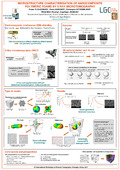
[en] Recent advances in microstructured materials have given rise to many new types of composites that exhibit original and interesting physical properties. For example, a nanocomposite made of carbon nanotubes inside a polymer matrix shows exceptional electromagnetic interference shielding effectiveness when foamed. However, the effective properties of such materials strongly depend on the shape and topology of the microstructural cells. An accurate method for investigating the cellular microstructure is X-ray microtomography (XRµT), for it is non-destructive, and it provides 3D geometric information. Although it cannot be used to observe nanofiller dispersion, it has a strong potential for cell structure characterization.
In order to reduce the need for trial and error for tailoring these materials, our objective is to characterize, using XRµT, two different types of foaming procedures, namely supercritical CO2 batch foaming and freeze drying. As the resolution is limited compared to cell size, we have developed a novel statistical method based on 3D autocorrelation to determine characteristic length and examine anisotropy. We present results for these two types of foams and show the limitations of this method.
Research center :
Laboratory of Chemical Engineering (LGC), Faculty of Applied Sciences, ULiège Centre for Education and Research on Macromolecules (CERM), Faculty of Sciences, ULiège
Disciplines :
Chemical engineering
Author, co-author :
Plougonven, Erwan ; Université de Liège - ULiège > Département de chimie appliquée > Génie chimique - Procédés et développement durable
Marchot, Pierre ; Université de Liège - ULiège > Département de chimie appliquée > Département de chimie appliquée
Detrembleur, Christophe ; Université de Liège - ULiège > Centre d'études et de rech. sur les macromolécules (CERM)
Tran, Minh Phuong ; Université de Liège - ULiège > Centre d'études et de rech. sur les macromolécules (CERM)
Léonard, Angélique ; Université de Liège - ULiège > Département de chimie appliquée > Génie chimique - Procédés et développement durable
Language :
English
Title :
Microstructure characterisation of nanocomposite polymeric foams by X-ray microtomography
Publication date :
21 September 2011
Number of pages :
A0
Event name :
4th International Workshop on Process Tomography
Event organizer :
International Society for Industrial Process Tomography Institute of Mechanics, Chinese Academy of Sciences
Event place :
Chengdu, China
Event date :
from 21-09-2077 to 23-09-2011
Audience :
International
Name of the research project :
ARC project 09/14-02 - From Imaging to geometrical modelling of complex micro structured materials: Bridging computational engineering and material science
Funders :
F.R.S.-FNRS - Fonds de la Recherche Scientifique [BE]